
Janet Jackson Pregnant at 50?
Can it be true?
Superstar Janet Jackson pregnant with her first child?
After months of speculation, Entertainment Tonight is reporting that the nearly 50 year old Jackson is having her first child with third husband, Wissam Al Mana, 41. Jackson and Al Mana had been secretly married in 2012, but didn’t acknowledge this until 2013.
Rumors of the pregnancy started flying when her world tour was put on hold last month. In a video on Twitter, Jackson said:
“We’re in the second leg of the tour and there actually has been a sudden change. I thought it was important that you be the first to know. My husband and I are planning our family, so I’m going to have to delay the tour.”
She went on to say to her fans:
“Please, if you could try and understand that it’s important that I do this now. I have to rest up, doctor’s orders. But I have not forgotten about you. I will continue the tour as soon as I possibly can.”
Jackson is another in a growing list of celebrities moms who have given birth after the age of 40. Others include:
Halle Berry 41
Kelly Preston 47
Celine Dion 42, twins
Mariah Carey 40, twins
Marcia Gay Harden 44, twins
Tina Fey 41
Selma Hayek 40
Susan Sarandon 39, 42, and 45
Molly Ringwald, twins
Gina Davis, 46 and 48, twins
Marcia Cross 45 twins
According to the American Society for Reproductive Medicine (ASRM), today 1 in 5 women in the United States has her first child after age 35. Most have healthy pregnancies and healthy babies, especially when they have good preconception and prenatal care. However, studies show that women in their mid-to-late 30’s and 40’s may face some special pregnancy risks.
What are the risks of pregnancy after 40?
Fertility:
All women begin to have a decrease in fertility, starting at age 30. It may be due to several things:
- Less frequent ovulation (release of an egg from the ovaries)
- Increased difficulty of an egg to become fertilized
- Medical conditions that are more frequent in older women such as blocked fallopian tubes and endometriosis
- Women who have had difficulty with fertility may be more likely to use assisted reproductive technologies (such as IVF)
Genetic Disorders:
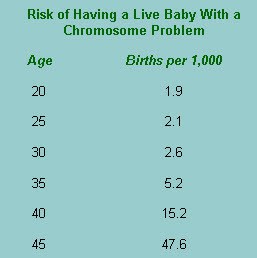 The risk of genetic disorders and birth defects increases with age.
Down’s Syndrome is the most common chromosomal birth defect.
All pregnant women, but especially those over 35 years old should be offered genetic screening or testing:
- Screening can be done by blood work or special ultrasound (they are not as accurate as genetic testing in determining the risk of genetic defects).
- Testing is done either by:
- amniocentesis : a small amount of amniotic fluid is taken from the sac around the baby, and infant cells in the fluid are analyzed. This is typically done at 15-20 weeks of pregnancy
- chorionic villus sampling: a small sample of cells is taken from the placenta and tested. This can be done at 10-12 weeks of pregnancy.
Health problems more common in older women:
- High blood pressure: can affect the placenta and the growth of the fetus.
- Diabetes, or gestational diabetes (diabetes which occurs only during pregnancy): It can cause the fetus to “overgrow”, called macrosomia. Diabetes can also lead to increase miscarriage and maternal blood pressure elevation.
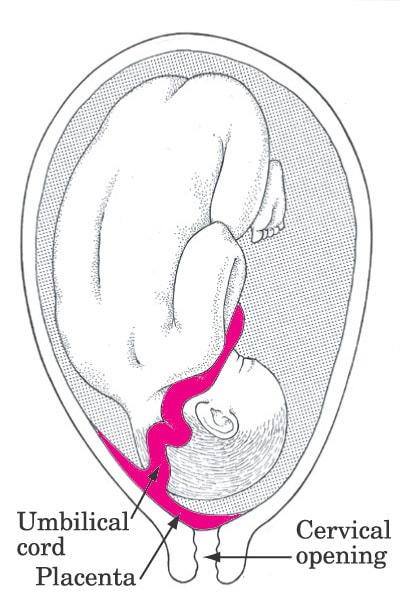 Placental problems: The most common placental problem is placenta previa (See diagram on left), in which the placenta covers part or all of the opening of the womb (cervix). Bleeding from a placenta previa can be severe, endangering the lives of both mother and infant. Women over 40 are 3 times more likely than younger women to have this complication.
- Prematurity of newborn:Women ages 40 and older are more likely than women in their 20s and 30s to deliver prematurely (before 37 completed weeks of pregnancy). Premature infants are more likely to be low birth weight, have increased health problems, some of which can have long term effects.
- Increased risk of C-section: Mothers over age 40 appear to be more than twice as likely as mothers under age 20 to have a c-section.
- Increased risk of twins: This is thought to be due to a release of more eggs during ovulation as a women ages (perhaps in an effort to increase the number of children born before menopause). Use of in vitro fertilization (IVF)to become pregnant often leads to multiples as several embryos are implanted at once in the hope that one will survive.
Although pregnancy over 40 has increased risks associated with it, with early and regular prenatal care, most pregnancies will have happy, healthy outcomes.

You may also like...



-
-
Advertisement

-
Advertisement
Dr. Michele Berman is now contributing to the American Association for Cancer Research.
 Why November is the Hairiest Month of the Year comment by Francisca Acosta
 World AIDS Day 2014 comment by Sajani Patel
 Kareem Abdul-Jabbar and the Magic Cancer Bullet comment by Kevin Li
 Kelly Ripa Diagnoses Herself With Mysterious Neurological Disorder comment by Kevin Li
 Why is Miley Cyrus Harming Herself? comment by Monica Bodd
 "Painfully Awkward Rob Lowe" Ad under Attack by "Shy Bladder" Advocates comment by Angelina Iyinbor
 Does Heidi Montag have a plastic surgery addiction? comment by Rachel Zimmerman
 Amanda Bynes Diagnosed as Bipolar comment by Monica Bodd
 Avicii Hospitalized, to Undergo Gall Bladder Surgery comment by Kevin Li
 Gina Rodriguez Surprised by Hashimoto's Diagnosis- UPDATED comment by Hannah Willey







0 comments